

In general, it can be said that the amount a baby needs to eat depends on several factors and that each baby is unique, with their own individual needs, but that there are general guidelines that can serve as guidance. In this article, we have collected such feeding guidelines and tips for you as a parent about what signals you can listen to in your child, where you can seek more information and when you should seek individual advice.
Giving your baby the right amount of formula is based on several factors.
Weight and age are two of the most important factors in determining how much formula a baby needs, as an older, heavier baby typically has a higher energy requirement than a newborn. In addition to age and weight, the amount is also affected by the baby's appetite, growth spurts, and activity level. Some babies have a naturally larger appetite and may need more food, while others may be satisfied with smaller amounts.
Another important aspect to understand and respect is that babies’ appetites don’t have to be constant – they can change from day to day and week to week, which can be due to factors such as growth phases and teething. During growth periods, babies can often show signs of increased hunger and need more formula than usual, while during other periods they may seem less hungry. As a parent, it’s important to pay attention to your baby’s hunger and satiety signals.
There is no universal solution that fits everyone
A very general rule of thumb for the amount of formula to feed a baby is that the baby needs approximately 150 ml of formula per kilogram of body weight per day. However, this should be seen for what it is – a general rule of thumb, rather than a guideline. Every baby is unique and an average or general level is therefore not necessarily desirable or applicable in every individual case. As mentioned, each child has their own individual needs that can be influenced by several factors. Babies develop at different rates, and their nutritional needs may well change from day to day. Understanding that there is no "one-size-fits-all" solution when it comes to feeding babies is crucial to creating a positive feeding experience.
How much allowance for a newborn baby
A newborn's stomach is very small, which means it can only handle small amounts of milk at first. Food intake is therefore in small amounts, but often at short intervals during the first few days. It is not unusual for a baby to want to eat up to 12 times a day in the early days. For some it is less often and for others even more often than that. The amount of formula at each feeding can be as little as a couple of milliliters on the first day, and should gradually increase over time.
A lot happens during the first few days, and most babies increase their intake from a total of about 20-30 ml/kg body weight per day to about 150 ml/kg body weight during the first seven days. Here it is once again important to remember that these are general levels, and that different babies have different needs.
Just like breastfed babies, it is important to let the baby control the intake of formula milk. The baby should be allowed to eat whenever they signal hunger, and each time they should be allowed to eat until they signal satiety. Parents should try to be sensitive to these signals and adapt feeding accordingly. If a newborn seems hungry after a feeding, it may indicate that they have a greater need. At the same time, it is important not to try to force the baby to eat more food than they want, to overfeed, as this can make it difficult for the baby to develop self-regulation of food intake.
On the packaging of infant formula there are general recommendations about how much formula is appropriate for babies of different ages. These, of course, do not take into account the baby's weight or other factors, and should therefore only be seen as general guidance. The portion sizes given in dosage tables can deviate from reality, especially in the very beginning, when a lot is happening and the variations can be large. The important thing is that the baby gets the nutrition it needs to grow and gain weight, which regular visits to the child health center help to check.
Amount of supplement based on your baby's age
As your baby grows and develops, their ability to receive and process larger amounts of formula also increases. It is still true that different babies have varying needs depending on, among other things, activity and growth rate, but in general, food intake should increase as the baby gets older and bigger. General levels show that babies at 2 months of age may need 100-160 ml of formula per meal, and a total of approximately 600-800 ml per day. At 4-6 months, the amount of formula can be 150-180 ml per meal and vary from a total of 600-1200 ml per day. The National Handbook for Child Health Care contains an overview of the amount of formula for babies based on estimated energy needs at different ages and average energy content in breast milk formulas. The values in the table are calculated for feeding only with formula. When partially breastfeeding or introducing food earlier than 6 months, the amounts in the table will of course need to be adjusted.
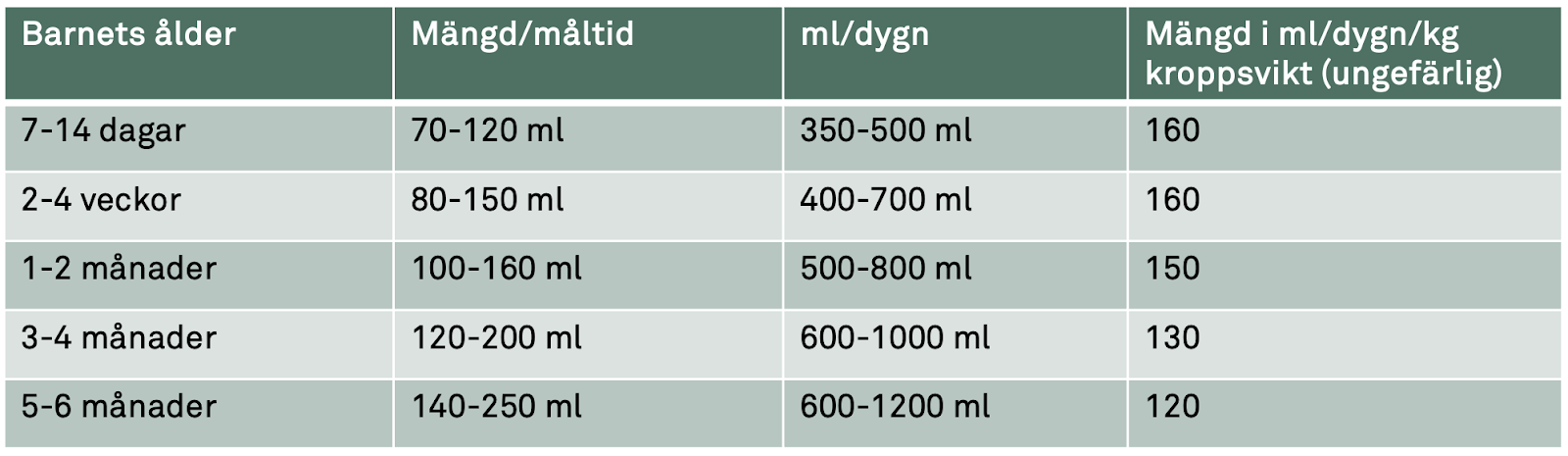
Table from the National Handbook of Infant Health Care. https://www.rikshandboken-bhv.se/amning-och-nutrition/brostmjolksersattning---oversikt/stodja-och-informera-om-brostmjolksersattning/ The amounts in the table (as well as tables on infant formula packaging) can be used as a guide, rather than as a goal to achieve the highest possible amount at each meal.
How do you know when your baby is full or still hungry?
Learning to read your baby's hunger and satiety cues can seem difficult at first, but is usually something you as a parent learn over time. It's about paying attention to body language and behaviors during feeding to try to develop an understanding of your baby's specific signals and needs. Below we list some common signs of hunger and satiety.
Signs of hunger
- Sucking on hands : A common early sign of hunger is when babies suck or chew on their hands, fingers, or other objects in their vicinity.
- Opening the mouth : When you offer the bottle or breast, a hungry baby may open their mouth and reach toward you, as a sign that they want to eat.
- Head movement : Babies can move their heads back and forth, often called the "rooting reflex," which is an instinct to search for food.
- Crying : Many parents soon learn that crying can be a sign of hunger, but it's important to note that crying can also be due to other factors.
- Increased activity : A hungry baby may also become more mobile and active, kicking his legs or waving his arms.
Signs of saturation
Crying or discomfort : Sometimes even a full baby may start to cry or seem uncomfortable if they are forced to eat more than they want.
Turning head away : When a baby is full, they may turn their head away when offered more food. This is a clear signal that they are no longer interested.
Closing the mouth : If you try to feed a baby who is full, they may close their mouth or even push the bottle or breast away.
Relaxed posture : When a baby is full, they may display a relaxed posture, which means they are not tense or restless.
Playing with a pacifier/nipple : A full baby may stop sucking and instead start playing with the bottle or breast, or holding it in a relaxed position.
How often should the baby eat?
There is no right or wrong way to feed a baby, but regardless of whether they are breastfed or bottle-fed, the baby should be in control of their intake – which is why it is important for parents to try to be sensitive to their baby’s signals and adjust the feeding frequency accordingly. Every baby has their own individual needs and preferences – some prefer to eat small amounts more often, while others eat larger amounts less often. Remember that needs and preferences can also change over time and as the baby grows, nothing is constant and does not necessarily have to be linear.
Here we provide an overview of the guidelines that exist regarding feeding frequency based on different age groups.
Newborns (0-1 month)
Newborns have very small stomachs and need to eat frequently to get the energy and nutrition they need for growth:
- Frequency : Newborns are usually fed every two to three hours, which gives 8-12 feedings per day.
Infants (1-4 months)
When babies are between 1 and 4 months old, they begin to be able to take in larger amounts of food, and their feeding schedule may stabilize somewhat:
- Frequency : For babies of this age, 6-8 feedings per day are common.
Older infants (4-6 months)
Around 4 months, babies may be more mature both physically and neurologically, which can affect their intake:
- Frequency : Babies aged 4 to 6 months may still eat 5-6 times a day, but some may start to adjust to more regular meals, perhaps reducing the number of feedings at night.
Summary of meals per day
- 0-1 month : 8-12 meals per day.
- 1-4 months : 6-8 meals per day.
- 4-6 months : 5-6 meals per day.
When should you contact a pediatrician?
If you are worried about your baby's health or suspect that they are not getting enough food, help is available. During the first few weeks, regular visits to the BVC can be very helpful in ensuring that the baby is growing and developing as it should, and at the BVC they can also guide and advise on whether it is time to seek further care.
Below we list some situations and symptoms that may indicate that you should seek medical care.
1. Unusual weight loss
If you notice that your baby is losing weight instead of gaining, this is a reason to contact a doctor. Newborns should usually start gaining weight within a few days of birth, and continued weight loss or lack of weight gain can be signs that something is wrong, such as inadequate nutritional intake or medical problems.
2. Signs of dehydration
Dehydration can be a serious situation for babies. Signs of dehydration include:
- Fewer diapers than usual (fewer than 6-8 diapers per day for newborns).
- Darker urine.
- Dry mouth or dry lips.
- Tired or lethargic behavior.
If you observe any of these symptoms, it is important to contact a pediatrician.
3. The baby refuses to eat
If your baby consistently refuses to eat and shows signs of resistance to taking the bottle or breast for several days, it could indicate an underlying health problem. This is especially true if it is accompanied by other symptoms such as fever or changes in behavior.
4. Vomiting
Vomiting can be a sign of a variety of problems, from mild stomach upset to more serious conditions. If your baby vomits frequently or if the vomit is green, yellow, or bloody, you should seek immediate help.
5. Persistent crying or discomfort
If your baby is crying persistently and seems to be in discomfort or pain, it may be a reason to consult a doctor, especially if the crying seems more intense or different than usual. This may indicate colic, allergic reactions, or other medical conditions.
6. Other symptoms that may indicate problems
- Fever of 38°C or higher in a newborn under 3 months.
- Swelling or redness around the belly button or other wounds.
- Symptoms of allergic reactions, such as rash, swelling or difficulty breathing.


